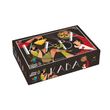
Do you love playing board games over a cup of coffee? Have you ever wondered how that drink makes its way to your table? In this abstract family game, you’ll have the chance to easily and casually experience every step of coffee production—from harvesting beans to delivering them to cafés.
Description of Café (Board Game)
Fans of strategic games that test spatial thinking, planning, and resource management will surely appreciate the minimalist design and structured approach—featuring concise cards and colorful cubes representing coffee reserves. Each player starts the game with an initial card and a set of cubic resources—one of each color. Then, at the beginning of each round, players take turns choosing one of three action cards, paying for the especially useful ones with their resources. Why bother, you ask, when we want to produce more coffee, not spend it on mysterious cards?
Gameplay
The essence of the game lies in laying out action cards—divided into various cells—in front of you to form company zones that grow your coffee business. The game features an unconventional card-playing mechanic: each new card must overlap part of the previous one(s)—covering 2, 3, or 4 cells. Cards can be rotated and layered multiple times, but once placed, they can’t be moved back. If a card covers resources, those must be returned to the general supply.
Another trick is to combine and place cards so that cells with the same actions are adjacent, creating large zones on your board that can be activated all at once. For example, this lets you harvest a rich yield of multiple coffee bean types in one go. Drying them, however, is a separate task—cubes of the same color fully occupy one drying cell, but a series of adjacent drying cells can again optimize production. The same applies to roasting. The final stage is delivering roasted beans to warehouses or cafés—which, by the way, are based on real establishments opened across Portugal over the years, from Faro in the south to the Viana do Castelo district in the north. Warehouses accept any coffee, but Portugal’s city cafés are pickier, awarding victory points only if the right colored cubes are in those cells at the game’s end.
How many cups of coffee do you drink a day? And how many cups will you manage to keep visible in your company after placing action cards? That’s how many action points you’ll have in the next round. The maximum is eight, and unused points burn away—like coffee spilling over from a Turkish cezve. Follow the adjacency principle, smartly combine action cards, and keep track of the sequence in your company’s operations. Production follows a strict chain, and any misstep means the guests at your cafés won’t enjoy freshly brewed coffee in the morning. The winner is the player who, after eight rounds, scores the most victory points from cafés and coffee cubes in their warehouses.
Café energizes players with a drive to hone their gaming skills. Though the coffee itself is represented by mere colored cubes at every production stage, this game of calculation and action planning is infused with the aroma of coffee beans and respect for Portugal’s history and culture. Thus, a concise and abstract strategy in stylish design becomes a delightful, atmospheric game for a perfect evening with friends or family.