


|
Quantity
|
Out of stock
|
||
|
|
|||
|
|
|||
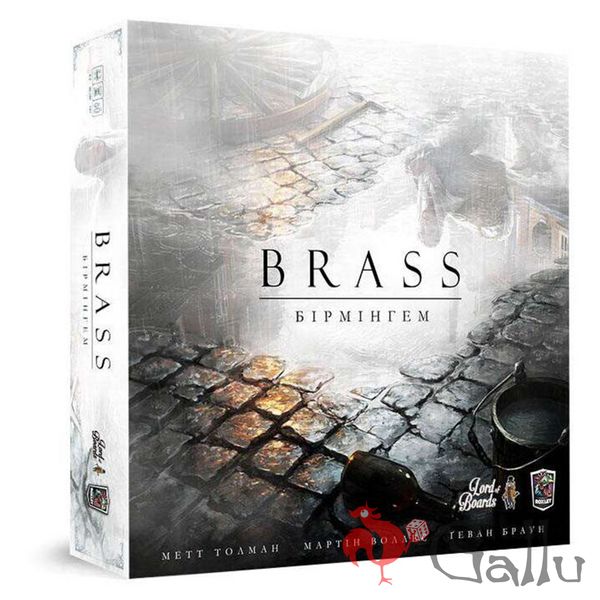
Brass. Birmingham is a deep and captivating Eurogame focused on resource management. Its creator, Martin Wallace, accomplished the near-impossible. The first version of Brass was released in 2007. Although the game was of high quality, it didn’t quite achieve star status. In 2017, Wallace re-released the game with a modern design, added interesting gameplay mechanics, and named it Brass: Lancashire. It was an instant success, and the game quickly climbed to the top ranks of the Board Game Geek ratings (as of 2024, it holds 20th place). But the creator didn’t stop there, and a year later, he crafted a true masterpiece—Brass. Birmingham! This improved version of the previous Brass games now holds the triumphant first place among all board games known to mankind.
About the game Brass. Birmingham
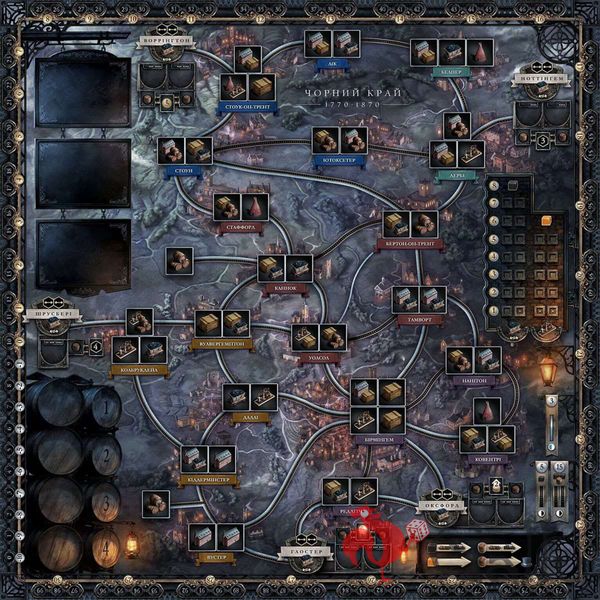
Set during the Industrial Revolution in Great Britain between 1770-1870, the game takes place in the county of West Midlands. In the industrial city of Birmingham, you will need to build an industrial empire, establish logistics, improve enterprises, sell goods, take out loans, and explore new opportunities.
How to play?
While the rules of the game might seem straightforward at first glance, the gameplay is filled with mechanics and nuances. Future magnates should also be prepared for the fact that one session of the game typically lasts from 2 to 3 hours.
The game spans two eras: the Canal Era and the Railway Era. On average, one era consists of 8-10 rounds. Out of six possible actions, a player can perform only two, and each action requires discarding a card. After completing all actions, replenish your hand to eight cards from the deck.
Building
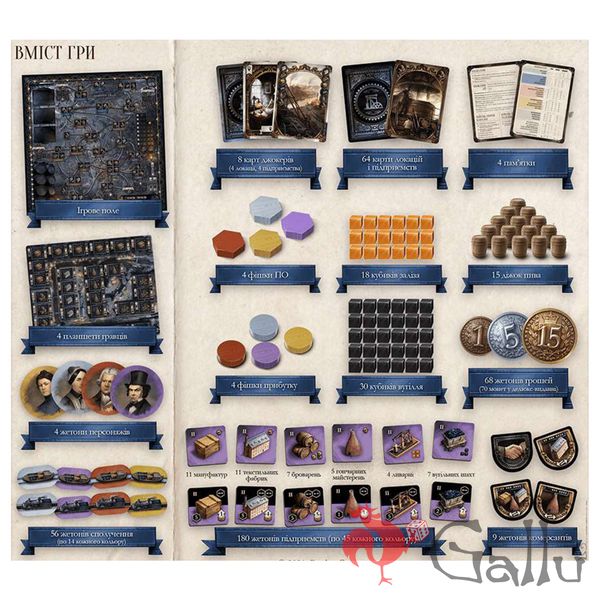
This is essentially the main mechanic of the game, allowing you to place industry tokens on the game board. Depending on the era, you can build a different number of enterprises. In the Canal Era, only one enterprise can be built per location, while in the Railway Era, multiple can be constructed. To build, you need to discard a card of the corresponding location or a joker, ensure the enterprise is logistically connected to a coal source, and spend the required amount of coins. Sometimes, you also need to pay the necessary resources (iron or coal). This way, a player can also upgrade their own lower-level enterprises or take over other players' mines and factories.
Connections
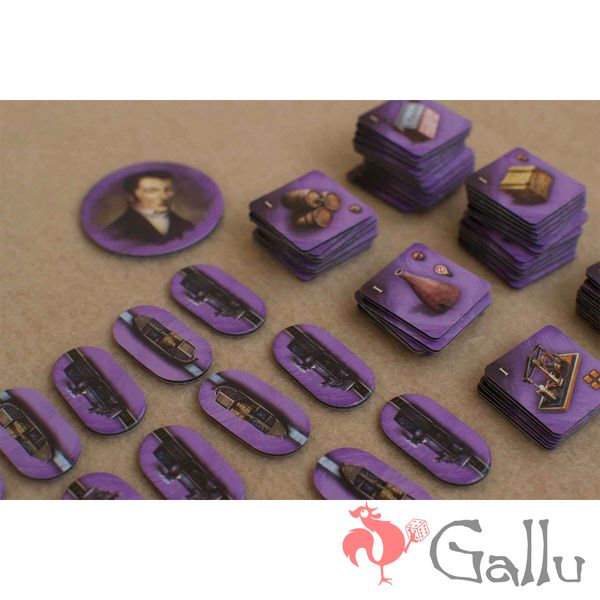
To expand the transport network and improve logistics, players can place connection tokens between cities on the appropriate spots on the board. To do this, you need to discard a card and pay three pounds.
Upgrade
Allows access to higher-level enterprises without the need to build all levels of that type. To do this, discard a card, remove a lower-level enterprise token from the player’s board, and pay one iron for each removed token.
Sales
Enables the sale of goods from textile mills, manufacturers, and pottery workshops. To perform this action, you need to have a connection to a merchant, flip the corresponding token, discard a card, spend barrels of beer if needed, and move the income marker up the progress track. This action can be repeated for each unflipped enterprise token.
Loan
You can borrow money. You don't need to repay it, but it will reduce your income level. To borrow 30 pounds, discard a card and move the marker three levels down the progress track. However, you won't be granted a loan if it reduces the income level below -10.
Exploration
This is a new action that allows you to obtain joker cards to facilitate building. To receive one joker-enterprise card and one joker-location card, you need to discard any three cards. However, if you already have a joker card in your hand, you cannot perform this action.
End of an era
Each era ends when players run out of cards in their hands. At the end of each era, players tally points for canals or railways and flipped enterprise tokens. The player with the most points wins the game.
We also recommend watching the video rules in the "Video" section and, if desired, reviewing the rules in detail with illustrations in PDF format in the "Files" section.
And finally
If you enjoy complex economic strategies, planning several moves ahead, and find analytical challenges euphoric, then Rooster Gallu gives you a firm handshake with both wings and wholeheartedly recommends this best board game in the world.